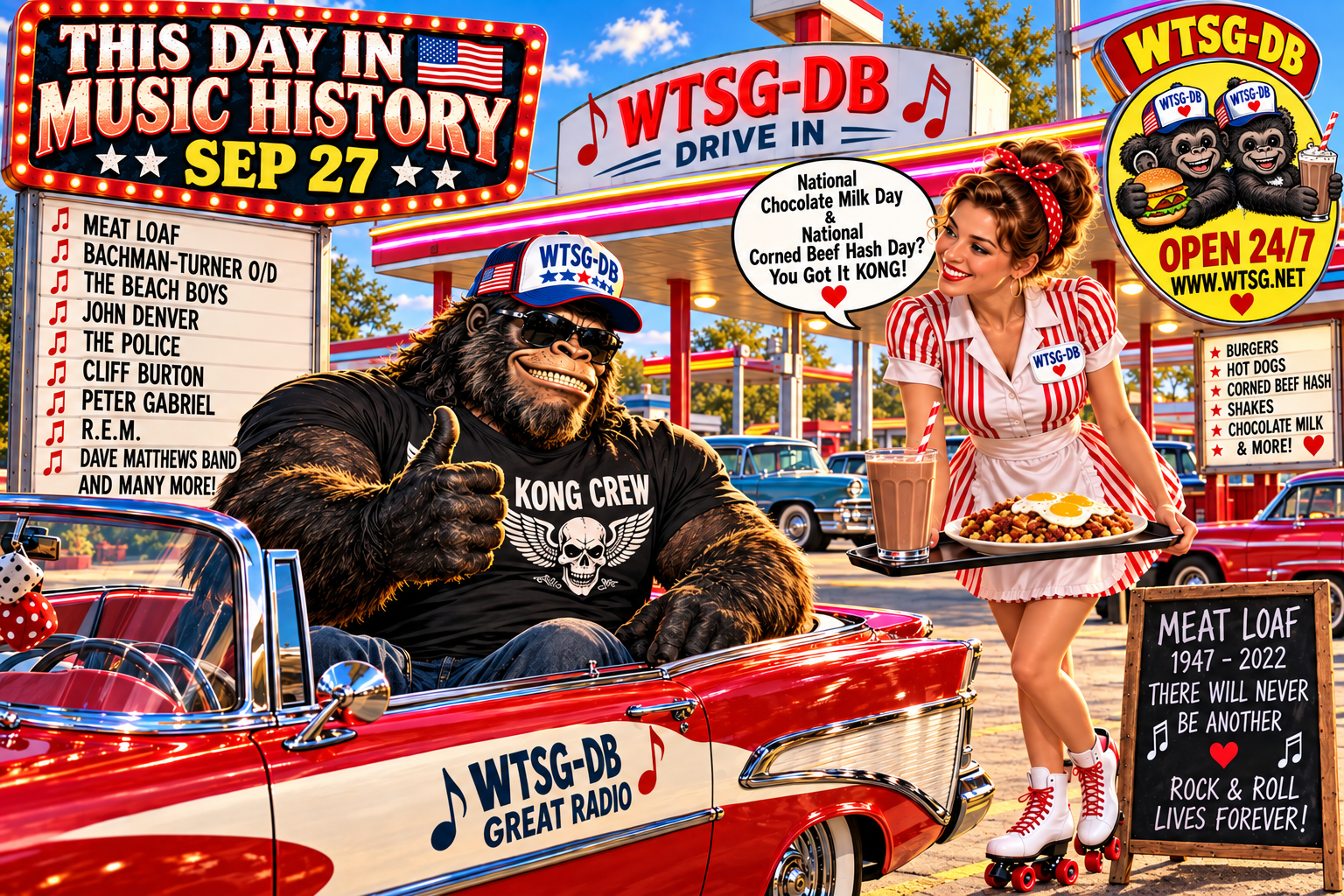
From the Desk of CLASSICKONG
Welcome back, music lovers, to another trip through the records, artists and moments that built the soundtrack of our lives.
Before we spin the first record, WTSG-DB proudly sends our thanks to the men and women of the United States Armed Forces—past and present—and to the families who stand beside them.
Today, that recognition carries an especially important meaning.
September 27, 2026, is Gold Star Mother’s and Family’s Day—a day set aside to honor the mothers and families of American service members who gave their lives in service to our country.
Behind every fallen hero is a family whose sacrifice continues long after the uniform has been folded and the flag has been presented.
To our Gold Star Mothers and Gold Star Families: WTSG-DB remembers your loved ones, honors their service and sends our deepest respect to you.
They are not forgotten.
Neither are you.
Today’s National Days
September 27 also brings us two observances considerably easier on the heart—and considerably harder on CLASSICKONG’s waistline.
It’s National Chocolate Milk Day.
It’s also National Corned Beef Hash Day.
Chocolate milk and corned beef hash?
At the same meal?
I’m not saying CLASSICKONG would do it.
I’m saying he’s already sitting at the counter waiting for his order.
Somewhere our WTSG-DB waitress is probably reconsidering every career decision that brought her to this moment.
Now that breakfast is handled, let’s turn up the music.
Because September 27 gives us an extraordinary collection of musicians.
Different styles. Different generations. Different ways of making their mark.
And nobody made his mark quite like the man we’re starting with.
Meat Loaf: Giving Everything to the Song
Marvin Lee Aday was born September 27, 1947, in Dallas, Texas.
The world would come to know him as Meat Loaf.
I’ve said before that Meat Loaf is one of my favorite rock singers of all time.
Maybe number one.
But calling Meat Loaf simply a great singer almost misses what made him so special.
It was the commitment.
When Meat Loaf sang a song, he gave himself to it. Completely.
Listen to Bat Out of Hell and tell me that man was holding anything back.
I don’t hear it.
What I hear is power. Soul. Drama. Pain. Joy. Desperation.
And an artist who sounds like he is living every word while the tape is rolling.
Bat Out of Hell arrived in 1977 on Cleveland International/Epic Records, with songs written by Jim Steinman and production by Todd Rundgren.
What those three created together was enormous.
It was rock and roll. It was theater. It was motorcycles, chrome, young love, heartbreak, angels, rebellion and teenage dreams blown up to cinematic proportions.
And right in the middle of it stood Meat Loaf.
“Bat Out of Hell.”
“You Took the Words Right Out of My Mouth.”
“Two Out of Three Ain’t Bad.”
“Paradise by the Dashboard Light.”
“For Crying Out Loud.”
These weren’t songs Meat Loaf simply performed.
He attacked them. He pleaded with them. He acted them.
He lived inside them.
And years before Bat Out of Hell made him a rock superstar, many of us had already met him as Eddie in The Rocky Horror Picture Show.
Big Eddie!
There was something larger than life about Meat Loaf from the beginning.
Then, sixteen years after the original Bat Out of Hell, Meat Loaf and Jim Steinman reunited for Bat Out of Hell II: Back into Hell in 1993 on MCA.
And somehow, they did it again.
“I’d Do Anything for Love (But I Won’t Do That)” became one of the defining songs of Meat Loaf’s career.
And yes, after all these years, people are still asking what exactly Meat Loaf wouldn’t do.
Some traditions should never die.
But behind the jokes was one of the most powerful performers rock and roll ever gave us.
Nobody, at least to me, symbolizes choppers and angels and rock and roll quite like Meat Loaf.
Put on Bat Out of Hell.
Turn it up.
Then listen to how much of himself that man gave you.
It can still be overwhelming.
Meat Loaf died January 20, 2022, at the age of 74.
God rest his soul.
There will never be another like him.
Randy Bachman: From The Guess Who to Overdrive
Another September 27 birthday belongs to one of classic rock’s great riff makers.
Randy Bachman was born September 27, 1943, in Winnipeg, Manitoba.
LEGEND.
And Randy gives us not one great band to celebrate, but two.
With The Guess Who, Bachman helped create records including “No Time,” “No Sugar Tonight/New Mother Nature” and the unmistakable guitar attack of “American Woman.”
Then came Bachman-Turner Overdrive.
BTO didn’t need fancy decorations.
They needed amplifiers.
“Takin’ Care of Business.”
“Roll On Down the Highway.”
“Let It Ride.”
And, of course:
“You Ain’t Seen Nothing Yet.”
Now THAT is CLASSICKONG music.
BTO’s Not Fragile, released in 1974 on Mercury, reached No. 1 in the United States and Canada and remains one of the defining records of the band’s career.
Even the title had attitude.
Yes had released Fragile.
BTO essentially answered:
Not us.
Randy Bachman built a career around riffs you recognize, songs you remember and a guitar sound that never needed an introduction.
The Guess Who.
Bachman-Turner Overdrive.
Two different chapters.
One enormous classic-rock footprint.
Russ Kunkel: The Drummer Behind the Records
Russ Kunkel was born September 27, 1948.
Now here is one for my fellow drummers.
Kunkel became one of the great session players of his generation.
And when you start connecting his name to the records he played on, his résumé is incredible.
He played drums and percussion on James Taylor’s Sweet Baby James (1970, Warner Bros.), including “Fire and Rain.”
He can be heard on Carole King’s landmark Tapestry (1971, Ode/A&M).
He played on Joni Mitchell’s Blue (1971, Reprise).
He was there for Jackson Browne’s The Pretender (1976, Asylum) and Running on Empty (1977, Asylum).
You can also find Kunkel on Warren Zevon’s Excitable Boy (1978, Asylum), Stevie Nicks’ Bella Donna (1981, Modern/Atco) and numerous other recordings.
And those are only a few stops on an enormous résumé.
Linda Ronstadt. Carly Simon. Bob Dylan. Crosby & Nash. Art Garfunkel. Bob Seger. Joe Walsh.
The list keeps going.
You may not have known Russ Kunkel’s name the first time you heard him.
But chances are good you knew the records.
That is the beauty of a great session musician.
The job isn’t to jump out of the speakers yelling:
“HEY! LISTEN TO ME!”
The job is to make the song work.
As a drummer, I’ve always believed that.
Serve the song.
Kunkel built a career doing exactly that.
He could give a song movement without crowding it. He could establish the groove and still leave room for everybody else.
And he could adapt that approach to artist after artist, session after session and song after song.
That takes more than chops.
It takes great ears, great feel and an understanding of what the music needs.
Sometimes leaving your mark means everybody knows your face.
Sometimes it means generations of people know the records you helped make.
Greg Ham: More Than One Famous Saxophone Riff
Greg Ham was born September 27, 1953, in Melbourne, Australia.
Most people probably associate him immediately with Men at Work and that wonderful saxophone part in “Who Can It Be Now?”
Fair enough.
It’s one of those musical signatures you recognize almost instantly.
But Greg Ham brought a lot more than one saxophone riff to Men at Work.
He played saxophone, flute, keyboards and other instruments, helping give the band much of its musical color.
And buddy, these cats could PLAY.
If your knowledge of Men at Work stops with “Who Can It Be Now?” and “Down Under,” go deeper.
One of my favorites is “Down by the Sea,” the closing track from Business as Usual (1981, CBS/Columbia).
That song breathes.
It stretches out.
It creates an atmosphere.
And it shows a side of Men at Work that somebody who only knows the radio singles might never expect.
These guys were musicians.
Business as Usual became an enormous international success, but there is much more on that record than the hits everybody knows.
Greg Ham died in April 2012 at only 58.
Far too young.
But every time that saxophone comes through the speakers, there he is.
Another musical fingerprint that never disappeared.
The Beach Boys Take The Ed Sullivan Show
On September 27, 1964, The Beach Boys made their first appearance on The Ed Sullivan Show.
They performed “I Get Around” and “Wendy.”
And for “I Get Around,” the stage even featured hot rods.
How much more Beach Boys could you possibly get?
But beneath the cars, surfboards and California image was some serious musicianship.
Brian Wilson was already demonstrating that pop music could be harmonically sophisticated while still sounding effortless coming out of a car radio.
Those Beach Boys harmonies became their fingerprint.
You hear a few seconds and you know.
That fits today perfectly.
Leave your mark.
Find your sound.
The Beach Boys certainly found theirs.
Don Kirshner Gives Rock and Roll the Stage
On September 27, 1973, Don Kirshner’s Rock Concert premiered in syndication.
So what exactly was Don Kirshner’s Rock Concert?
It was a weekly syndicated television music series created and hosted by legendary music executive Don Kirshner that brought major rock artists into American living rooms.
And Kirshner didn’t exactly start small.
The Rolling Stones helped launch the program with their first American television appearance in more than four years.
But the important part was how the music was presented.
Instead of treating a rock band like a quick novelty act squeezed between comedy sketches and commercials, Don Kirshner’s Rock Concert gave musicians room to perform.
The show featured full-length performances in live concert and club settings rather than relying on the lip-synced studio appearances common on many television music programs of the era.
And over the years, the program featured an extraordinary list of artists, including KISS, Rush, the Eagles, Foghat, Kansas, the Ramones, Van Morrison and the Allman Brothers Band.
Think about what that meant in 1973.
There was no YouTube. No streaming. No pulling a phone out of your pocket and watching a concert from twenty years ago.
You bought the record. You heard the band on the radio. Maybe you saw them in a magazine.
But actually getting to watch your favorite rock bands perform on television was something special.
That’s why shows like Don Kirshner’s Rock Concert mattered.
Kirshner understood something important.
If you have great musicians, give them a stage.
Then let them play.
John Denver Says I’m Sorry and Goes to Number One
On September 27, 1975, John Denver reached No. 1 on the Billboard Hot 100 with “I’m Sorry.”
John Denver has always been one of those artists whose music feels completely sincere to me.
“Rocky Mountain High.”
“Sunshine on My Shoulders.”
“Thank God I’m a Country Boy.”
Great songs.
Denver didn’t need to overpower you.
He could draw you in.
That was his gift.
And that gives us another way of looking at today’s theme.
Leaving your mark doesn’t always require turning everything to eleven.
Sometimes it’s one voice.
One acoustic guitar.
One honest song.
John Denver knew how to make that enough.
The Police: Three Musicians, One Unmistakable Sound
On September 27, 1980, The Police began a four-week run at No. 1 on the UK Singles Chart with “Don’t Stand So Close to Me.”
The song was written by Sting and appeared on Zenyatta Mondatta (1980, A&M Records).
What a trio The Police were.
Sting.
Andy Summers.
Stewart Copeland.
Three very different musicians whose individual styles somehow locked together into one unmistakable sound.
Sting brought the songs, the bass and that instantly recognizable voice.
Andy Summers brought texture, space and a guitar vocabulary that sounded nothing like the usual rock approach of the period.
And behind them was Stewart Copeland.
As a drummer, I can recognize that man almost immediately.
The hi-hat work. The cymbal splashes. The reggae influence. The accents. The space.
But Copeland wasn’t creating that music by himself.
His playing worked because it was interacting with Sting and Summers.
That push and pull was part of the magic.
Three musicians.
Three distinct musical personalities.
One band that sounded like nobody else.
That’s leaving a mark.
Cliff Burton: A Musical Mind Gone Far Too Soon
September 27, 1986, brought one of heavy music’s great losses.
Metallica bassist Cliff Burton was killed when the band’s tour bus crashed during an overnight drive in Sweden.
He was only 24.
We don’t need to dwell on the accident.
The music tells us what we need to know about Cliff Burton.
Burton brought an unusually broad musical vocabulary to Metallica.
He understood music theory.
He brought experimentation into the band.
And he helped expand the role of bass within Metallica’s sound.
Listen to “(Anesthesia)—Pulling Teeth” from Kill ’Em All (1983, Megaforce).
Listen to “Orion” from Master of Puppets (1986, Elektra).
Then listen to the musical growth across Ride the Lightning (1984, Elektra) and Master of Puppets (1986, Elektra).
Twenty-four years old.
Think about that.
We can only imagine where his musicianship might have taken him.
What he left behind was enough to make his mark permanent.
Ferris Bueller Sends The Beatles Back Up the Chart
On September 27, 1986, The Beatles’ recording of “Twist and Shout” was sitting at No. 23 on the Billboard Hot 100, more than two decades after its original American chart run.
Funny how the Twist kept finding its way back into popular music.
Back in 1960, Chubby Checker had everybody doing “The Twist.”
In 1961, he told us, “Let’s Twist Again.”
Then in 1963 and 1964, The Beatles were making us “Twist and Shout!”
And more than twenty years later, they were doing it again.
This time, Ferris Bueller helped.
Ferris Bueller’s Day Off featured “Twist and Shout” during that unforgettable Chicago parade sequence and helped introduce the Beatles recording to another generation.
That’s one of the wonderful things about a great record.
Sometimes all it takes is the right movie, television show or cultural moment for an old song to suddenly sound brand new again.
And somewhere CLASSICKONG is doing the Twist.
Nobody asked him to.
But here we are.
Peter Gabriel Gets Personal with Us
On September 27, 1992, Peter Gabriel released Us.
The album arrived six years after the massive success of So.
Rather than simply trying to make So Part II, Gabriel went somewhere more personal.
Us explored relationships, communication, pain and emotional distance.
“Digging in the Dirt.”
“Come Talk to Me.”
“Blood of Eden.”
“Steam.”
Gabriel again worked with producer Daniel Lanois, and the album incorporated musicians and sounds from around the world.
And look who turns up among the contributors.
Brian Eno.
There’s that name again.
Yesterday we were talking about Bryan Ferry, Roxy Music and Eno—and Eno’s later work with David Bowie.
One day later, there he is in the Peter Gabriel story.
Funny how music history keeps connecting the dots for us.
Other contributors to Us included John Paul Jones, Sinéad O’Connor and Peter Hammill.
Us was released through Real World/Geffen in the United States.
Peter Gabriel had already made enormously successful music.
With Us, he continued following his own instincts.
That’s another kind of fingerprint.
September 27, 1994: One Hell of a Record-Store Tuesday
Imagine walking into a record store on September 27, 1994.
Look what was waiting for you.
Walter Becker — 11 Tracks of Whack
Walter Becker released his first solo album, 11 Tracks of Whack, on Giant Records.
First of all:
11 Tracks of Whack.
That title alone tells you something about Walter Becker.
The dry humor. The intelligence. The slightly crooked way of looking at the world.
All of the things I love about Steely Dan were still living inside Becker’s musical personality.
Donald Fagen produced the record, making the connection to Steely Dan impossible to miss.
I still can’t believe Walter is gone.
But put this record on and that mind is still there.
Still clever.
Still musical.
Still Walter Becker.
R.E.M. — Monster
The same day brought R.E.M.’s Monster on Warner Bros.
After the comparatively acoustic character of Out of Time and Automatic for the People, R.E.M. turned the amplifiers back up.
Peter Buck’s distorted guitars helped give Monster a dense, aggressive identity.
“What’s the Frequency, Kenneth?”
“Bang and Blame.”
“Crush with Eyeliner.”
R.E.M. had already found enormous success.
They still weren’t interested in making the same record forever.
Dave Matthews Band — Under the Table and Dreaming
And on that very same September 27, Dave Matthews Band released its major-label debut, Under the Table and Dreaming, on RCA.
“What Would You Say.”
“Ants Marching.”
“Satellite.”
“Jimi Thing.”
“Typical Situation.”
And if the harmonica on “What Would You Say” catches your ear, that’s John Popper from Blues Traveler.
The album was produced by Steve Lillywhite and introduced a much larger audience to a band that could combine memorable songs with serious musicianship.
Three records.
One day.
Walter Becker.
R.E.M.
Dave Matthews Band.
September 27, 1994, must have been a pretty expensive Tuesday for somebody walking into a record store with good taste.
Birthday Roll Call
September 27 gives us quite a birthday lineup.
Randy Bachman — born September 27, 1943
Guitarist, songwriter and founding force in The Guess Who and Bachman-Turner Overdrive.
Meat Loaf — Marvin Lee Aday — September 27, 1947 – January 20, 2022
One of rock music’s most powerful and theatrical voices.
Russ Kunkel — born September 27, 1948
One of the great session drummers, heard across an extraordinary collection of classic records.
Greg Ham — September 27, 1953 – April 2012
Multi-instrumentalist whose saxophone, flute and keyboards helped give Men at Work their unmistakable musical personality.
Must-Have Discogs
Today gave us a lot of music.
If any of these stories sent you looking for something to put on the turntable, here are a few places to start.
Meat Loaf — Bat Out of Hell
1977 — Cleveland International/Epic
The essential Meat Loaf record. Jim Steinman’s songs, Todd Rundgren’s production and a singer giving absolutely everything.
Meat Loaf — Bat Out of Hell II: Back into Hell
1993 — MCA
Sixteen years later, Meat Loaf and Steinman returned to that universe and proved there was still plenty of fire left.
Bachman-Turner Overdrive — Not Fragile
1974 — Mercury
Heavy riffs, big hooks and “You Ain’t Seen Nothing Yet.” Classic BTO.
Carole King — Tapestry
1971 — Ode/A&M
An essential singer-songwriter album and one of the many landmark recordings featuring Russ Kunkel behind the drums.
Joni Mitchell — Blue
1971 — Reprise
Another remarkable Kunkel credit and one of the defining singer-songwriter albums of its era.
Jackson Browne — Running on Empty
1977 — Asylum
Songs about the road actually recorded on the road, with Russ Kunkel helping hold down the rhythm section.
Men at Work — Business as Usual
1981 — CBS/Columbia
Go beyond the hits. Make sure “Down by the Sea” gets its turn.
Metallica — Ride the Lightning
1984 — Elektra
A major step forward in Metallica’s development and an essential document of Cliff Burton’s era.
Metallica — Master of Puppets
1986 — Elektra
One of the defining heavy records of its generation and Cliff Burton’s final studio album with Metallica.
Peter Gabriel — Us
1992 — Real World/Geffen
Personal, adventurous and beautifully produced.
Walter Becker — 11 Tracks of Whack
1994 — Giant
Walter Becker outside Steely Dan, although that unmistakable musical intelligence came right along with him.
R.E.M. — Monster
1994 — Warner Bros.
R.E.M. plugs back in and gets noisy.
Dave Matthews Band — Under the Table and Dreaming
1994 — RCA
Songs, musicianship and the record that introduced millions to DMB.
Super-Hero Trading Cards
Meat Loaf
Real Name: Marvin Lee Aday
Born: September 27, 1947 — Dallas, Texas
Died: January 20, 2022 — age 74
Superpower: Total commitment
Weapon of Choice: One enormous voice
Essential Album: Bat Out of Hell
Signature Move: Turning a rock song into a three-act drama
CLASSICKONG Rating: Turn it up and get out of the way.
Randy Bachman
Born: September 27, 1943 — Winnipeg, Manitoba
Superpower: The riff
Weapons of Choice: Guitar and songwriting
Teams: The Guess Who / Bachman-Turner Overdrive
Essential Album: Not Fragile
Signature Move: Making a few chords sound like they could move a building.
Russ Kunkel
Born: September 27, 1948
Superpower: Feel
Weapon of Choice: Drums and percussion
Essential Skill: Knowing exactly what the song needs
Signature Move: Serving the song without sacrificing personality.
Greg Ham
Born: September 27, 1953 — Melbourne, Australia
Died: April 2012 — age 58
Superpower: Musical color
Weapons of Choice: Saxophone, flute and keyboards
Essential Album: Business as Usual
Signature Move: Playing a few notes and making everybody recognize the song.
The Final Spin
Ok, time for today’s Final Spin.
Today’s stories covered a lot of musical ground, from Meat Loaf and Randy Bachman to The Beach Boys, John Denver, The Police, Peter Gabriel and some incredible musicians behind the scenes. Different styles and different generations, but the common thread is unmistakable. Great musicians leave their mark by giving us something that belongs to them. Sometimes it’s a voice, a riff or a drumbeat. Sometimes it’s simply the way an artist gives everything they have to a song.
Meat Loaf certainly did that. Put on Bat Out of Hell and nearly fifty years later, you can still feel the power.
And that’s really the thread linking all of today’s stories—leaving your mark. Whether you’re “Takin’ Care of Business” or heading “Down by the Sea,” when you give everything you have to the music, you’re leaving behind more than your mark. You’re leaving a gift for the rest of us to enjoy long after the final note has faded.
And that’s why we’ve celebrated all of these wonderful artists today.
Ok, that’s gonna wrap things up for today. We appreciate you takin’ time out for us, and we hope we had a story you liked and hopefully put a smile on your face.
Take care of yourselves, take care of each other, and we’ll catch ya on the next This Day in Music History.
So long, everybody!
— CLASSICKONG
WTSG-DB
Listen to Today’s Podcast
Want to hear today’s trip through music history instead?
Join CLASSICKONG and WTSG-DB for the spoken-word edition of This Day in Music History — September 27, where we take the guided tour through the stories, records and musicians that left their mark.
Turn it up, settle in and enjoy the ride.
References
Gold Star Mother’s and Family’s Day — U.S. Department of Veterans Affairs
Meat Loaf — Biography and Career Overview
Randy Bachman — Official Website
Carole King — Tapestry Album and Personnel
Russ Kunkel — AllMusic Credits
The Beach Boys on The Ed Sullivan Show
Don Kirshner’s Rock Concert — Official History
The Rolling Stones on Don Kirshner’s Rock Concert
John Denver — Official Website
The Police — “Don’t Stand So Close to Me” — Official Charts
The Beatles — Official Website
Dave Matthews Band — Official Website