From the Desk of CLASSICKONG
Welcome back, music lovers, to another trip through the records, musicians and moments that made music history.
Before we turn up the volume, WTSG-DB sends our continued thanks to the men and women of the United States Armed Forces—past and present. Your service and sacrifice are never taken for granted.
September 18 is absolutely loaded.
Black Sabbath delivers one of heavy metal’s foundational albums. Genesis tears up its own rulebook with Abacab. Boston sends a song onto the charts that still carries memories nearly half a century later. The Beatles somehow build “Birthday” in one marathon session. We celebrate Kansas mastermind Kerry Livgren, jazz guitarist Emily Remler and the immortal Charlie “Bird” Parker.
And apparently somebody at KISS headquarters REALLY liked September 18.
But before we plug in the amplifiers, CLASSICKONG has some important business to attend to.
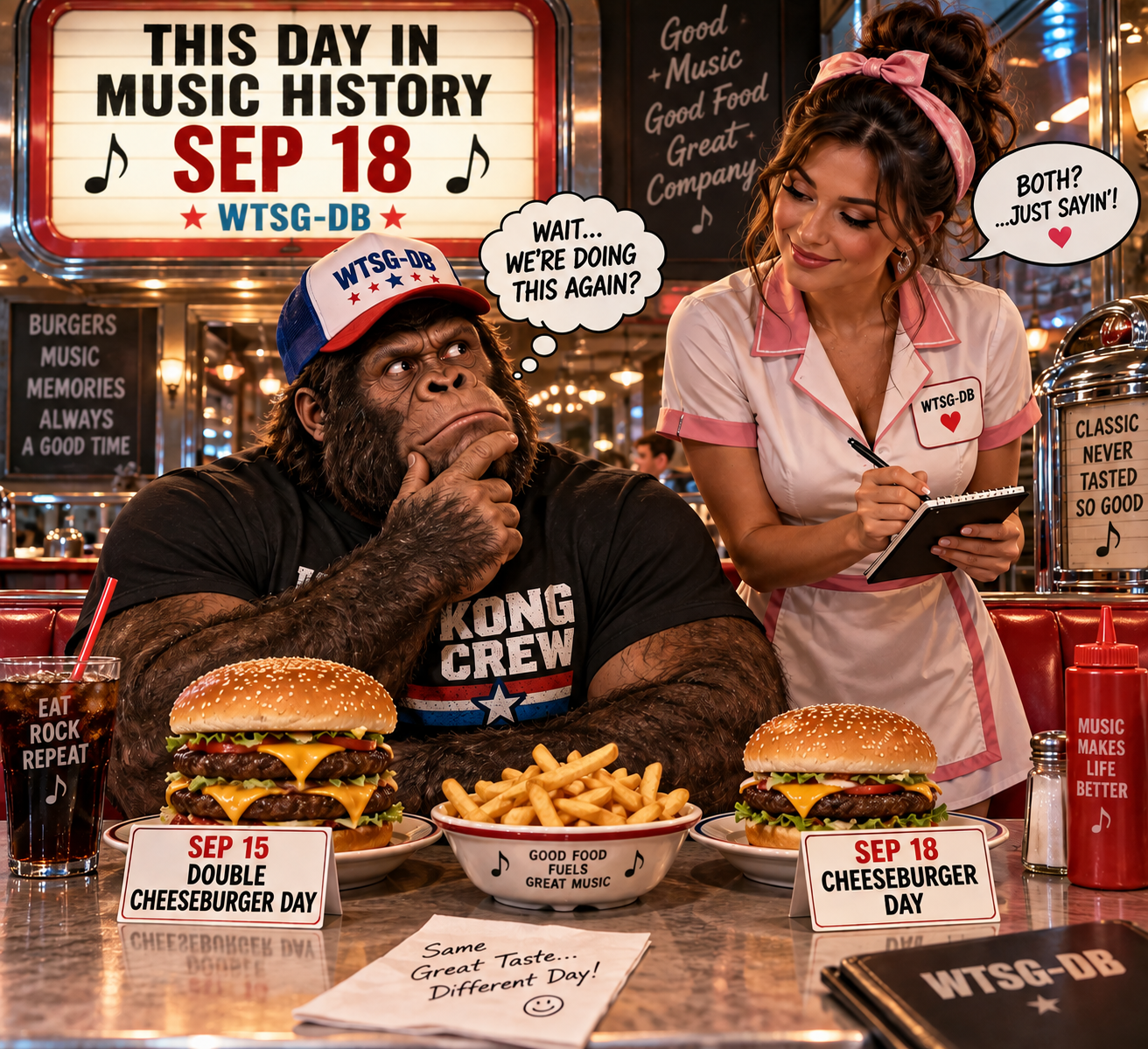
National Cheeseburger Day — Wait… Didn’t We Just Do This?
September 18 is National Cheeseburger Day.
And if you’re experiencing a little déjà vu, there’s a good reason.
Just a few days ago, on September 15, we celebrated National Double Cheeseburger Day.
Apparently America decided one cheeseburger holiday wasn’t enough.
I respect that.
The double cheeseburger had its day. Today we remove one patty, call it a completely different national celebration, and start all over again.
Who am I to argue with that kind of logic?
Beef. Cheese. Bun.
Lettuce and tomato if you’re feeling responsible.
Bacon if you’re not.
And since this is CLASSICKONG we’re talking about, somebody better bring the fries.
Now that we’ve handled the important stuff…
let’s turn up the music.
KISS — The September 18 Triple Threat
Some dates belong to particular bands.
For KISS, September 18 is almost ridiculous.
September 18, 1978 — Four Men, Four Solo Albums
KISS did something enormous on September 18, 1978: Gene Simmons, Paul Stanley, Ace Frehley and Peter Criss simultaneously released individual solo albums.
All four were issued by Casablanca Records, packaged with matching Eraldo Carugati portraits and marketed as part of the KISS universe.
Yet musically, each member was essentially free to show listeners who he was away from the band.
And that’s what makes these records so fascinating.
Paul’s album sounds unmistakably like Paul.
Gene wanders all over the musical map.
Peter leans into the R&B, soul and rock-and-roll influences that helped make him the Catman.
And Ace?
Well…
If CLASSICKONG has to grab one of the four off the shelf, I’m reaching for Ace.
Ace Frehley’s album simply rocks.
“Rip It Out.”
“Snow Blind.”
“Ozone.”
“Fractured Mirror.”
And then there’s his cover of Russ Ballard’s “New York Groove.”
The song became a No. 13 U.S. hit and gave Ace the biggest hit single produced by the four-album experiment.
There was always something wonderfully unpolished about Ace.
He didn’t need to be Gene.
He didn’t need to be Paul.
He just needed a Les Paul, an amplifier and enough room to be Space Ace.
CLASSICKONG Trading Card Stats — The Original KISS Lineup
PAUL STANLEY — THE STARCHILD
Born: January 20, 1952
Position: Vocals / Rhythm Guitar
Classic Weapon: Ibanez Iceman / Washburn signature guitars
1978 Solo LP: Paul Stanley
Label: Casablanca Records
Solo Cuts to Know: “Tonight You Belong to Me,” “Move On,” “Wouldn’t You Like to Know Me,” “It’s Alright”
KISS Essentials: KISS (1974), Alive! (1975), Destroyer (1976)
GENE SIMMONS — THE DEMON
Born: August 25, 1949
Position: Bass / Vocals
Classic Weapon: Axe- and Punisher-style basses
1978 Solo LP: Gene Simmons
Label: Casablanca Records
Solo Cuts to Know: “Radioactive,” “See You Tonite,” “Mr. Make Believe”
Wild Card: Gene even closes the record with “When You Wish Upon a Star.”
KISS Essentials: KISS (1974), Alive! (1975), Destroyer (1976)
ACE FREHLEY — THE SPACEMAN
April 27, 1951 – October 16, 2025
Position: Lead Guitar / Vocals
Classic Weapon: Gibson Les Paul — preferably smoking
1978 Solo LP: Ace Frehley
Label: Casablanca Records
Solo Cuts to Know: “Rip It Out,” “Snow Blind,” “New York Groove,” “Fractured Mirror”
KISS Essentials: KISS (1974), Alive! (1975), Destroyer (1976)
PETER CRISS — THE CATMAN
Born: December 20, 1945
Position: Drums / Vocals
Classic Weapon: Drum kit, sticks and that unmistakable raspy voice
1978 Solo LP: Peter Criss
Label: Casablanca Records
Solo Cuts to Know: “You Matter to Me,” “Don’t You Let Me Down,” “I Can’t Stop the Rain”
KISS Essentials: KISS (1974), Alive! (1975), Destroyer (1976)
Must-Have Discography — The Original KISS Lineup
KISS (1974, Casablanca)
Hotter Than Hell (1974, Casablanca)
Dressed to Kill (1975, Casablanca)
Alive! (1975, Casablanca)
Destroyer (1976, Casablanca)
Rock and Roll Over (1976, Casablanca)
Love Gun (1977, Casablanca)
Alive II (1977, Casablanca)
The four 1978 solo albums (Casablanca)
And today, especially, we remember Ace Frehley.
The Spaceman left us in 2025, but those records aren’t going anywhere.
September 18, 1983 — KISS Takes Off the Makeup
Exactly five years later, KISS did something fans once thought almost unimaginable.
They showed everybody their faces.
On September 18, 1983, KISS appeared on MTV without their trademark makeup, publicly unveiling the band’s new image while promoting Lick It Up.
The album was also released that day in the United States on Mercury/PolyGram.
But this wasn’t the original four anymore.
Gene Simmons and Paul Stanley remained, joined by Eric Carr on drums and Vinnie Vincent on guitar.
I’ve always wondered how much bigger that reveal might have felt if Gene, Paul, Ace and Peter—the four mysterious faces kids had spent years trying to see—had all still been standing there together.
We’ll never know.
The unmasking received plenty of resistance from longtime fans, but it also marked the beginning of another chapter in KISStory.
September 18, 1987 — Crazy Nights
And here comes number three.
Several discographic sources list Crazy Nights as a September 18, 1987 release, while other detailed KISS references give September 21 for the U.S. release.
So we’re putting an asterisk beside this one rather than pretending the documentation agrees completely.
Either way, September apparently belonged to KISS.
TRIPLE THREAT—with a discographical asterisk.
Only KISS.
Black Sabbath — Paranoid Changes Heavy Music
On September 18, 1970, Black Sabbath released Paranoid in the United Kingdom on Vertigo Records.
The United States would get it January 7, 1971, through Warner Bros. Records.
Look at this lineup:
Ozzy Osbourne — vocals
Tony Iommi — guitar and keyboards
Geezer Butler — bass
Bill Ward — drums
And then look at the songs:
“War Pigs.”
“Paranoid.”
“Planet Caravan.”
“Iron Man.”
“Electric Funeral.”
“Hand of Doom.”
“Rat Salad.”
“Fairies Wear Boots.”
That’s not merely an album.
That’s practically a heavy-metal instruction manual.
The record was produced by Rodger Bain and recorded primarily at Regent Sound and Island Studios.
More than five decades later, guitar players are still learning Iommi riffs, drummers are still studying Bill Ward’s wonderfully loose swing, bassists are still chasing Geezer’s lines, and Ozzy’s voice remains inseparable from the sound.
Must-Have Black Sabbath
Black Sabbath (1970, Vertigo/Warner Bros.)
Paranoid (1970 UK / 1971 US, Vertigo/Warner Bros.)
Master of Reality (1971, Vertigo/Warner Bros.)
Vol. 4 (1972, Vertigo/Warner Bros.)
Sabbath Bloody Sabbath (1973, WWA/Warner Bros.)
Sabotage (1975, NEMS/Warner Bros.)
Start with Paranoid.
Then turn it up.
Genesis — Abacab Tears Up the Rulebook
Now THIS ONE is special.
On September 18, 1981, Genesis released Abacab in the United Kingdom on Charisma Records.
The American release followed one week later through Atlantic Records.
It reached No. 1 in Britain and became Genesis’ first Top 10 album in the United States, reaching No. 7.
Phil Collins — drums and vocals.
Tony Banks — keyboards.
Mike Rutherford — guitars and bass.
That’s already one hell of a lineup.
But Genesis was changing.
Abacab represented a conscious effort to break established Genesis traditions—different structures, fewer extended instrumental passages and a new approach to arrangement.
Engineer and producer Hugh Padgham helped the band push into the enormous drum sound that would become one of the signatures of the decade.
And then comes one of those discoveries that makes doing this column so much fun.
Listen to “No Reply at All.”
Hear those horns?
Those are the Phenix Horns—the horn section associated with Earth, Wind & Fire.
HOW DID I LISTEN TO THIS ALBUM ALL THESE YEARS AND NEVER PUT THAT TOGETHER?
Once you know it, you can’t un-hear it.
Earth, Wind & Fire’s horn power dropped into a band containing Collins, Banks and Rutherford.
That’s just another layer of greatness stacked onto an already ridiculous collection of musicians.
And somehow it works perfectly.
Other essentials include “Abacab,” “Keep It Dark,” “Man on the Corner” and the sprawling “Dodo/Lurker.”
Must-Have Genesis — Collins Era
A Trick of the Tail (1976, Charisma/Atco)
Wind & Wuthering (1976, Charisma/Atco)
…And Then There Were Three… (1978, Charisma/Atlantic)
Duke (1980, Charisma/Atlantic)
Abacab (1981, Charisma/Atlantic)
Genesis (1983, Charisma/Atlantic)
Abacab wasn’t Genesis abandoning musicianship.
It was Genesis discovering another way to use it.
What a freakin’ album.
Boston — “More Than a Feeling” Enters the Hot 100
On September 18, 1976, Boston’s “More Than a Feeling” entered the Billboard Hot 100.
It eventually climbed to No. 5 and spent 19 weeks on the chart.
The song came from Boston’s extraordinary self-titled debut album on Epic Records.
Tom Scholz wrote it.
Brad Delp sang it.
And nearly fifty years later, it still doesn’t sound old.
This song is especially personal to me.
Every time I hear “More Than a Feeling,” I find myself thinking about loved ones I’ve lost along the pathway of life.
That’s one of music’s greatest powers.
A song can become attached to people, places and moments.
Years pass.
Life changes.
People leave us.
Then one familiar guitar chord comes through the speakers…
and suddenly they’re close again.
Maybe that’s why “More Than a Feeling” has always felt like more than just another classic-rock song to me.
Must-Have Boston
Boston (1976, Epic)
Don’t Look Back (1978, Epic)
Honestly, those first two records alone tell you an awful lot about why Boston matters.
Kerry Livgren — Carrying On
Kerry Livgren was born September 18, 1949.
Guitarist. Keyboardist. Composer. Founding force behind Kansas.
And the man wrote two songs that belong permanently in the classic-rock vocabulary:
“Carry On Wayward Son.”
And:
“Dust in the Wind.”
Livgren wrote nearly all of 1976’s Leftoverture, including “Carry On Wayward Son,” and followed it with the deeply reflective “Dust in the Wind” on 1977’s Point of Know Return.
I love old Kansas.
My Dad loved Kansas too.
And maybe that’s another reason these songs hit me differently.
Both are reflective in completely different ways.
“Carry On Wayward Son” wrestles with searching, struggle and meaning.
“Dust in the Wind” strips everything down to how temporary our time really is.
They’re songs you can discover when you’re young…
and somehow understand differently when you’re older.
Kerry Livgren — CLASSICKONG Trading Card Stats
Born: September 18, 1949
Position: Guitar / Keyboards / Composer
Band: Kansas
Classic Weapons: Electric and acoustic guitars, keyboards and synthesizers
Signature Compositions: “Carry On Wayward Son,” “Dust in the Wind”
Progressive-Rock Credentials: Off the chart
Must-Have Kansas
Song for America (1975, Kirshner)
Masque (1975, Kirshner)
Leftoverture (1976, Kirshner)
Point of Know Return (1977, Kirshner)
Two for the Show (1978, Kirshner)
Monolith (1979, Kirshner)
Kansas could rock.
Kansas could get complicated.
And Kansas could make you think.
That’s classic Kansas.
They Say It’s Your Birthday! — The Beatles Build a Classic
September 18, 1968.
EMI Studios.
The Beatles walk in at approximately 5:00 p.m.
By the time they leave around 4:30 the following morning, “Birthday” essentially exists.
The session ran through 20 takes, followed by overdubs and a mono mix.
Think about that.
A song that has been blasted at birthday parties for generations came together during one marathon Beatles session.
“Birthday” eventually appeared on The Beatles—better known as the White Album—released later in 1968 on Apple Records.
Sometimes music history involves months of painstaking work.
Sometimes four Beatles walk into Abbey Road and basically say:
Let’s make a birthday song.
Twenty takes later…
Happy birthday to everybody forever.
The Beach Boys — Smiley Smile
On September 18, 1967, the Beach Boys released Smiley Smile through Brother/Capitol Records.
The album emerged from the complicated aftermath of Brian Wilson’s famously ambitious Smile project and presented much of the material in a considerably more stripped-down setting.
But look what’s sitting on the record:
“Heroes and Villains.”
“Vegetables.”
“Wonderful.”
“Wind Chimes.”
And a little record called…
“Good Vibrations.”
Smiley Smile reached No. 41 in America but performed substantially better in Britain, reaching No. 9.
Must-Have Beach Boys
Surfer Girl (1963, Capitol)
All Summer Long (1964, Capitol)
The Beach Boys Today! (1965, Capitol)
Pet Sounds (1966, Capitol)
Smiley Smile (1967, Brother/Capitol)
Surf’s Up (1971, Brother/Reprise)
Eagles — Somebody’s Gonna Hurt Tonight
On September 18, 1979, the Eagles released “Heartache Tonight” on Asylum Records, backed with “Teenage Jail.”
The songwriting credits alone are impressive:
Don Henley.
Glenn Frey.
Bob Seger.
J.D. Souther.
Glenn Frey handled the lead vocal, Bill Szymczyk produced it, and the song eventually reached No. 1 on the Billboard Hot 100.
I’ve always thought there’s something slightly ominous underneath this song.
It’s catchy as all get-out.
But the entire premise is essentially:
Somebody’s going to get hurt tonight.
That’s not exactly an invitation to a relaxing evening.
But that stomping beat, those handclaps and Frey’s vocal make the thing almost impossible not to sing along with.
It appeared on The Long Run, released later that month on Asylum Records.
Emily Remler — Talent Doesn’t Care About Stereotypes
Emily Remler was born September 18, 1957, in Englewood Cliffs, New Jersey.
She died May 4, 1990, at only 32 years old, while on tour in Australia.
Her death was reported as heart failure.
Thirty-two.
That’s difficult to comprehend when you hear how mature her playing already was.
Remler came out of the jazz-guitar tradition of Charlie Christian and Wes Montgomery, eventually working with musicians including Ray Brown, Eddie Gomez, Larry Coryell and Nancy Wilson.
And there’s another part of Emily Remler’s story worth saying out loud.
Jazz guitar—like rock guitar—has historically been an overwhelmingly male world.
Then here comes Emily.
She didn’t need somebody to make room for her by lowering the bar.
She could PLAY.
Harmony.
Time.
Chord vocabulary.
Single-note improvisation.
Touch.
Swing.
Put the guitar in her hands and the stereotype became irrelevant.
And I think there’s something pretty cool about that—especially for those of us coming from the rock world, where the image of the “guitar hero” has traditionally been a guy standing in front of a Marshall stack.
Great musicianship doesn’t care who’s holding the instrument.
Emily Remler — CLASSICKONG Trading Card Stats
September 18, 1957 – May 4, 1990
Position: Jazz Guitar
Classic Weapon: Red Gibson ES-330
Primary Influence Lineage: Charlie Christian / Wes Montgomery
Associated Players: Ray Brown, Eddie Gomez, Larry Coryell, Nancy Wilson
Primary Label: Concord Jazz
Special Ability: Swinging like crazy without wasting notes
Must-Have Emily Remler
Firefly (1981, Concord Jazz)
Take Two (1982, Concord Jazz)
Transitions (1983, Concord Jazz)
Catwalk (1985, Concord Jazz)
Together with Larry Coryell (1985, Concord Jazz)
East to Wes (1988, Concord Jazz)
She deserved more time.
But she left enough behind to prove the point.
Never judge the musician before you hear the music.
Bird Is in the House — “Parker’s Mood”
Any day that gives us Charlie Parker gets our attention.
On September 18, 1948, Charlie “Bird” Parker recorded “Parker’s Mood” in New York for Savoy Records.
The session featured:
Charlie Parker — alto saxophone
John Lewis — piano
Curley Russell — bass
Max Roach — drums
Five takes were attempted—two false starts and three complete performances.
Read that lineup again.
Bird. John Lewis. Curley Russell. Max Roach.
That’s not a backing band.
That’s a jazz history lesson.
“Parker’s Mood” is essentially Parker taking the blues and speaking through the alto saxophone.
Charlie Parker
August 29, 1920 – March 12, 1955
Only 34 years.
Yet we’re still studying what he played.
Must-Have Bird
Charlie Parker with Strings (1950, Mercury)
Bird and Diz — with Dizzy Gillespie (1952, Clef)
Now’s the Time: The Quartet of Charlie Parker (1956, Verve; posthumous)
The Complete Savoy & Dial Master Takes (2002, Savoy Jazz)
For the serious Bird student, those Savoy and Dial recordings are where an enormous part of the bebop revolution lives.
If you’re learning jazz—or saxophone—you eventually meet Bird.
There’s really no way around him.
Ernest Tubb and Country Music Walk Into Carnegie Hall
On September 18, 1947, country music stepped onto one of America’s most prestigious stages.
Ernest Tubb and a Grand Ole Opry contingent appeared at Carnegie Hall in New York, part of performances held September 18–19.
Historical documentation identifies the event as an important early country-music presentation at Carnegie Hall.
That’s worth remembering.
Country music wasn’t always welcomed into America’s most prestigious concert rooms.
Artists such as Tubb helped carry it there.
Ernest Tubb
February 9, 1914 – September 6, 1984
Must-Have Ernest Tubb
Look for collections featuring:
“Walking the Floor Over You”
“Waltz Across Texas”
“Thanks a Lot”
“Blue Christmas”
Sometimes music history isn’t about a record.
Sometimes it’s about walking through a door that had previously been closed.
Remembering Jimi Hendrix — He Was Still Looking Forward
We can’t mark September 18 without acknowledging Jimi Hendrix, who died on this date in 1970 at only 27.
But we’ve discussed Hendrix’s death and the “27 Club” several times recently.
So today I want to remember something different.
One week before he died, Jimi Hendrix was talking about the future.
On September 11, 1970, journalist Keith Altham sat down with Hendrix at London’s Cumberland Hotel.
Neither man knew it would become Hendrix’s final interview.
That’s what makes it so poignant now.
Hendrix wasn’t talking like someone whose musical story was finished.
He was still thinking.
Still searching.
Still wondering where the music might take him next.
He had already given us:
Are You Experienced (1967, Track/Reprise)
Axis: Bold as Love (1967 UK / 1968 US, Track/Reprise)
Electric Ladyland (1968, Track/Reprise)
Band of Gypsys (1970, Capitol)
And yet Hendrix himself didn’t see those records as the destination.
He was wondering what came next.
Seven days later, there would be no next chapter.
That’s the part that gets me.
We usually look backward at Hendrix and marvel at everything he accomplished in such a short period of time.
But in that final interview, Jimi was looking forward.
Imagine what he still heard in his head that the rest of us never got to hear.
Jimi Hendrix
November 27, 1942 – September 18, 1970
Twenty-seven years old.
The tragedy isn’t only what music lost that day.
It’s all the music that hadn’t been made yet.
Final Spin
Some days in music history give us a collection of interesting dates.
September 18 gave us something more.
KISS showed us the power of individuality.
Four members stepped outside the band on the same day in 1978 and showed four very different musical personalities. Five years later, the band took off the makeup and discovered whether KISS could survive when part of the mystery disappeared.
Whatever you think of the different eras, there was courage in finding out.
Genesis showed us that expanding your musical vocabulary doesn’t mean abandoning the musician you already are.
Abacab brought new textures, new production ideas and even the Phenix Horns into the picture.
Collins, Banks and Rutherford spread their wings—and discovered another side of what they could do.
Black Sabbath’s Paranoid reminds us what can happen when four musicians find exactly the right chemistry.
Those riffs, rhythms and songs weren’t manufactured to become historic.
Four guys made a brutally powerful record—and generations of musicians have been chasing that feeling ever since.
Emily Remler reminds us how foolish stereotypes become when somebody walks into the room and can flat-out play.
The guitar doesn’t care whether you’re a man or a woman.
Neither does swing.
Neither does talent.
Charlie Parker reminds us that the calendar doesn’t measure a musician’s impact.
Bird had only 34 years.
We’re still trying to catch up with him.
Jimi Hendrix was only 27—and one week before his death, he was still wondering where the music might go next.
And then there’s Boston.
“More Than a Feeling” does something to me that I can’t reduce to chart positions, guitar tones or record sales.
When that song comes on, people I have loved and lost along the pathway of my life sometimes come back with it.
Not literally.
But close enough to matter.
A face.
A room.
A voice I haven’t heard in years.
A moment I didn’t realize would someday become precious while I was actually living it.
That’s one of the mysteries of music.
We think we’re simply listening to songs as life happens around us.
Years later, we discover those songs were quietly keeping pieces of our lives for us.
Then one comes through the speakers…
and opens the door.
Maybe only for four minutes.
But sometimes four minutes is enough.
That’s why this music matters.
Not because it’s old.
Not because somebody put the word “classic” in front of it.
It matters because somewhere along the way, it became part of who we are.
Until tomorrow, keep listening—and never underestimate what a song may be saving for you.
—CLASSICKONG
WTSG Digital Broadcasting
Great Music. Great Radio. Great Community.
Listen to Today’s Broadcast
Hear the spoken-word edition of This Day in Music History right here on WTSG-DB.
And while you’re here, stop by our Guestbook and say hello. We always enjoy hearing from the people who keep the signal alive.
Welcome to our Spotify listeners—and don’t forget to follow WTSG-DB so you don’t miss the next trip through music history.
References
- Black Sabbath Online — Paranoid Discography & Release History
- Rhino — September 1981: Genesis Releases Abacab
- KISS Timeline — The Four 1978 Solo Albums
- KISS Concert History — Lick It Up
- KISS Concert History — Album & Chart Archive
- Boston Official Website — Boston History
- Kansas Official Website — Discography
- Kansas Historical Society — Kerry Livgren
- Emily Remler — Official Memorial Website & Biography
- Glenn Frey Online — Eagles Archival Liner Notes
- Rock’s Backpages — Jimi Hendrix: The Final Interview with Keith Altham
- National Today — National Cheeseburger Day