From the Desk of CLASSICKONG
Good morning, music family.
Some days in music history give us a handful of interesting anniversaries. September 14 gives us a journey.
Today we’ll begin with Little Richard pounding a piano in New Orleans and helping ignite rock & roll. We’ll encounter storms with Jethro Tull, two remarkable chapters from Megadeth, the return of Meat Loaf and Jim Steinman, Uriah Heep still carrying the torch, the fearless piano of Cecil Taylor, the enduring music of Bob Marley, and an almost unbelievable birthday coincidence involving a whole shipment of guitar players.
Along the way, we’re going to talk about joy, danger, experience, second chances, mortality, gratitude—and why some records become part of our lives.
And before we begin, from this United States Air Force veteran and everyone at WTSG Digital Broadcasting: thank you to the men and women of the United States Armed Forces—past and present—for your service.
Let’s drop the needle.
1955 — Little Richard Lights the Fuse with “Tutti Frutti”
On September 14, 1955, Little Richard entered J&M Studio in New Orleans for Specialty Records.
The session wasn’t initially producing what producer Robert “Bumps” Blackwell wanted.
Then Richard sat down at the piano during a break.
What followed helped change popular music.
Richard tore into an outrageous, pounding number he’d been performing in various forms called “Tutti Frutti.” Blackwell heard something special. The song’s original risqué lyrics were rewritten into something Specialty could release, and with a group of terrific New Orleans musicians—including the great Earl Palmer on drums—Little Richard recorded one of the foundational performances of rock & roll.
That opening cry alone announced that something had changed.
The piano attacked. The drums drove. Richard screamed, sang and preached simultaneously.
Rock & roll suddenly sounded dangerous, joyful and almost impossible to contain.
There are records that become hits.
And then there are records that help establish the vocabulary for everything that comes afterward.
“Tutti Frutti” belongs in the second category.
1974 — Bob Marley’s Song Reaches No. 1 Through Eric Clapton
On September 14, 1974, Eric Clapton’s version of “I Shot the Sheriff” reached No. 1 on the Billboard Hot 100.
But before Clapton recorded it, it belonged to Bob Marley and the Wailers, appearing on their 1973 album Burnin’.
Clapton’s recording helped place a Marley composition before an enormous mainstream American audience, but Marley gave the song its identity.
And when we talk about Bob Marley, we should remember the larger body of work.
His music could speak about oppression and injustice, but Marley continually reached toward something greater:
Freedom. Peace. Faith. Dignity. Love.
Late in his life, “Redemption Song” stripped much of that message down to a voice, an acoustic guitar and a challenge to carry songs of freedom forward.
That matters today.
Experience should make us wiser.
It doesn’t have to make us colder.
Bob Marley understood the difference.
God rest his soul. ❤️
1979 — Jethro Tull Watches the Storm Roll In
On September 14, 1979, Jethro Tull released Stormwatch.
Coming after Songs from the Wood (1977) and Heavy Horses (1978), Stormwatch completed what is often viewed as Tull’s late-’70s folk-rock trilogy.
But this time the atmosphere had darkened.
The record concerns itself with weather, the sea, environmental pressures and change. Even the title works on more than one level: sometimes you’re watching a literal storm approach; sometimes you’re watching circumstances change around you and realizing there isn’t much you can do to stop them.
There was also genuine sadness surrounding the album.
Bassist John Glascock was suffering serious health problems and appeared on only part of the record. Ian Anderson handled much of the remaining bass work. Glascock died on November 17, 1979, at only 28 years old.
Stormwatch therefore became more than another Jethro Tull album.
It marked the approaching end of an era.
I recently watched Ian Anderson interviewed by Andy Edwards, and once again I came away appreciating how thoughtful Anderson remains about music and his career.
And roses to Andy as well. 🌹
He’s a musician talking with musicians, and that perspective matters.
Sometimes you can see the storm coming.
Sometimes you can’t.
Either way, eventually we all learn something about weathering one.
1992 — Megadeth Begins the Countdown
September 14 is an extraordinary date in Megadeth history.
On this day in 1992, the band released Countdown to Extinction.
Dave Mustaine. David Ellefson. Marty Friedman. Nick Menza.
That lineup was operating as one formidable machine.
The album gave us “Skin o’ My Teeth,” “Symphony of Destruction,” “Architecture of Aggression,” “Foreclosure of a Dream,” “Sweating Bullets,” and the title track.
The album reached No. 2 on the Billboard 200, becoming Megadeth’s highest-charting studio album at the time, and eventually achieved multi-platinum status in the United States.
And good grief…
“Symphony of Destruction”
OMG…I’M ROCKIN’, BUDDY! 🤘😂
That riff doesn’t politely enter the room.
It kicks the damn door open.
But underneath those riffs is something worth remembering.
The title Countdown to Extinction reminds us that permanence is often an illusion.
Species disappear.
Eras end.
Things we assumed would always be around sometimes aren’t.
At twenty years old, forever seems perfectly reasonable.
Get a few decades behind you and you start realizing how precious right now actually is.
1993 — Meat Loaf Goes Back to Hell
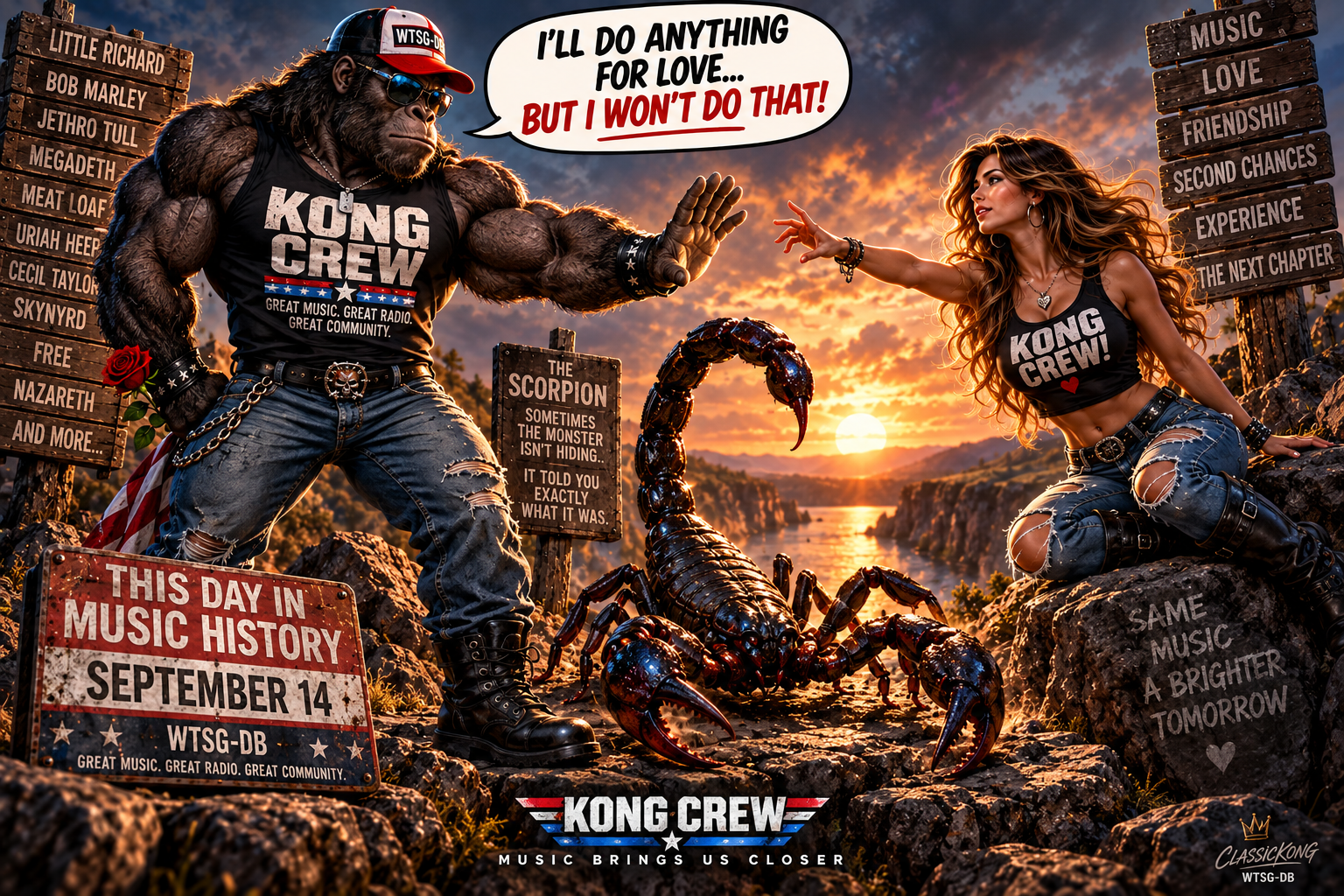
One year later, on September 14, 1993, Meat Loaf and Jim Steinman returned to the world they’d created together with Bat Out of Hell II: Back into Hell.
Sixteen years had passed since Bat Out of Hell.
How do you follow a record like that?
My answer is:
You don’t.
You cannot make Bat Out of Hell for the first time twice.
So you go forward.
And Bat Out of Hell II went forward BIG.
The album included “I’d Do Anything for Love (But I Won’t Do That),” “Life Is a Lemon and I Want My Money Back,” “Rock and Roll Dreams Come Through,” and the magnificent “Objects in the Rear View Mirror May Appear Closer Than They Are.”
This record deserves more love than it sometimes receives.
Jim Steinman’s songs were enormous—part rock & roll, part theater, part melodrama, part teenage dream, with the emotional controls permanently stuck at maximum.
And Meat Loaf was one of the few singers on Earth who could make that universe believable.
People sometimes remember the theatrical side of Meat and forget what a powerful, physical performer he really was.
This was a big Texas guy. He played football. He was Eddie in The Rocky Horror Picture Show.
Meat was a badass.
He could be funny, vulnerable, frightening and larger than life.
And when Meat Loaf sang a Steinman song, he didn’t stand outside the song and perform it.
He climbed inside the damn thing.
There was always something strong about his singing.
He poured everything he had into those performances. When Meat sang about desperation, love, regret or longing, you believed the man’s entire existence depended upon reaching the final note.
My wife and I absolutely love Meat Loaf.
I still have trouble believing he’s gone.
So today we’re giving Meat his roses again. 🌹
So…What Wouldn’t He Do for Love?
People have joked about this since 1993.
But the song actually answers the question.
“That” changes according to the promises Meat has just made.
He won’t forget the way she feels. He won’t stop dreaming about her. And during the female portion of the song, when she predicts that eventually he’ll move on and be unfaithful, he rejects that too.
There isn’t one mysterious forbidden act.
The answers are in the song.
Sometimes you’ve just gotta listen. 😉
2004 — Megadeth Returns September 14: The System Has Failed
Twelve years after Countdown to Extinction, Megadeth returned to the exact same calendar date.
On September 14, 2004, The System Has Failed was released.
This one is personal.
I wore this record OUT working third shift.
“Blackmail the Universe.”
“Die Dead Enough.”
“Kick the Chair.”
“The Scorpion.”
“Of Mice and Men.”
I couldn’t stop listening to it.
And all these years later, while preparing today’s history, I learned something that nearly knocked this drummer out of his chair:
Vinnie Colaiuta Played Drums on This Record
Wait…
WHAT?! 😂🥁
Yes.
THAT Vinnie Colaiuta.
The astonishing drummer whose résumé includes Frank Zappa, Sting, Jeff Beck and an enormous range of jazz, fusion and session work was sitting behind the kit on a Megadeth record I’d been cranking all those years.
And according to Dave Mustaine, Vinnie recorded the album’s drum parts in only three days.
Suddenly I’m wondering whether part of the reason my drummer’s ear couldn’t leave this record alone was sitting behind the drum kit the entire time.
Vinnie Colaiuta showed us drummers why we love to drum. 🥁❤️
Then add former Megadeth guitarist Chris Poland, who returned to play lead guitar on the record, and The System Has Failed becomes an even more fascinating album.
The Scorpion
And then there’s “The Scorpion.”
This one deserves more than a track listing.
The frightening thing about the scorpion isn’t simply that it carries venom.
It knows what it is.
It knows how to get close.
It can tell you what you want to hear—and then comes the sting.
There’s an old lesson some of us learn only through experience:
When someone repeatedly shows you who they are, believe the pattern.
Sometimes they showed us what they were and we chose not to believe it.
Sometimes we thought:
Maybe I can change them.
But understanding someone’s nature doesn’t necessarily give us the power to rewrite it.
Think about a starving lion.
You can admire the lion. Respect it. Explain that you’re a wonderful human being with people waiting for you at home.
The lion may find your argument fascinating.
CHOMP. 😂🦁
That doesn’t mean we should walk through life suspicious of everybody.
It means experience should teach us the difference between hope and evidence.
And that’s why “The Scorpion” can be more frightening than some imaginary Halloween monster.
Sometimes the monster isn’t hiding.
Sometimes it told you exactly what it was—and you chose not to believe it.
2018 — Uriah Heep Is Still Living the Dream
On September 14, 2018, Uriah Heep released their 25th studio album, Living the Dream.
And yes…
I own this one. 🤘
By 2018, Uriah Heep had already spent nearly half a century carrying the banner for British hard rock.
They didn’t need to prove they existed.
They didn’t need another record merely to keep the merchandise table stocked.
They made one anyway.
That’s the part worth celebrating.
Living the Dream wasn’t simply an old band surviving.
It was a working band still creating.
Founding guitarist Mick Box remained at the center of it all, still carrying that unmistakable Uriah Heep spirit into another generation.
There is something beautiful about musicians who refuse to treat creativity as something with an expiration date.
Maybe Living the Dream doesn’t mean everything went according to plan.
Maybe it means you survived enough changes to understand what the dream actually was.
Cecil Taylor — Refusing to Stay Inside the Lines
On September 14, 1956, pianist Cecil Taylor entered the studio for a session that contributed to his debut album, Jazz Advance.
Joining Taylor were Steve Lacy on soprano saxophone, Buell Neidlinger on bass and Dennis Charles on drums.
If your idea of jazz piano is quiet background music over dinner…
Cecil Taylor would like a word. 😂🎹
Taylor treated the piano almost like an enormous percussion instrument. Rhythm, clusters, attack, dissonance, physicality and improvisational freedom became parts of a language that helped push jazz toward the avant-garde.
You don’t have to love every piece of difficult music to respect the person willing to explore somewhere new.
Taylor refused to stay inside the lines.
Music needed people like that too.
September 14 Birthdays — Somebody Ordered Guitar Players
Apparently September 14 had a standing order at the guitar factory.
And in 1949, somebody accidentally ordered three at once. 😂🎸
Steve Gaines — Born September 14, 1949
Future Lynyrd Skynyrd guitarist, singer and songwriter Steve Gaines was born on this day in 1949.
Gaines joined Skynyrd later in the band’s original run, but his impact was immediate. His guitar playing, songwriting and vocals brought another dimension to an already formidable band, and his contributions to Street Survivors (1977) showed just how much potential he possessed.
Steve Gaines died in the October 20, 1977 plane crash that also took Ronnie Van Zant, Cassie Gaines, Dean Kilpatrick, and pilots Walter McCreary and William Gray.
He was only 28.
Far too young—and with so much music undoubtedly still inside him.
But here’s where September 14 gets downright strange.
Ed King — Born September 14, 1949
Same day. Same year. Same future band.
Ed King was also born September 14, 1949.
King first found success with Strawberry Alarm Clock before eventually joining Lynyrd Skynyrd and becoming an important part of that famous three-guitar attack.
He was also one of the writers of “Sweet Home Alabama.”
Think about this for a second:
Ed King and Steve Gaines—two guitarists who would occupy places in Lynyrd Skynyrd—were born on exactly the same day in exactly the same year.
September 14, 1949.
Music history occasionally hands you a coincidence so strange that all you can do is shake your head.
And apparently the guitar factory still wasn’t finished.
Fred “Sonic” Smith — Born September 14, 1949
Because Fred “Sonic” Smith of MC5 was born that very same day too.
Three rock guitarists.
One birthday.
September 14, 1949.
Smith helped supply the Detroit fire of MC5, whose loud, aggressive mixture of garage rock and hard rock helped point toward music that would eventually be called punk.
Their famous battle cry?
“Kick Out the Jams.”
September 14 apparently received a bulk shipment of battle-axes in 1949. 😂🎸
Paul Kossoff — Born September 14, 1950
Then exactly one year later, September 14 apparently said:
“Send me another one.” 😂
This time it was Paul Kossoff, guitarist for Free.
And naturally…
“ALL RIGHT NOW!” 🤘
Kossoff didn’t need a thousand notes to command your attention.
His weapons were vibrato, sustain, phrasing and space.
That’s an important lesson for guitarists—and musicians generally.
Speed can be impressive.
But sometimes one beautifully placed note can say more than thirty.
Kossoff died in 1976 at only 25 years old.
Far too young.
But that guitar still speaks.
Pete Agnew — Born September 14, 1946
Okay, we’ve ordered enough guitars.
Somebody better bring in the bottom end. 😎
Because every good guitar player needs a good foundation underneath him—somebody holding down the groove, carrying the bottom end and helping give all those guitars somewhere to live.
That’s where Pete Agnew comes in.
Born September 14, 1946, Pete is the founding bassist of Nazareth.
And around here, everybody already knows how much respect and admiration we have for this band—and especially for the late, great Dan McCafferty.
Dan possessed one of rock music’s great battle-axes of his own:
That voice.
Rough. Powerful. Soulful. Immediately recognizable.
But behind that unmistakable voice and those guitars, somebody had to hold down the foundation.
Pete Agnew did exactly that.
He was there from the beginning and became one of Nazareth’s great anchors through decades of records, touring and change.
Nazareth carried on after Dan’s death in 2022. Continuing doesn’t mean replacing him.
Some voices simply cannot be replaced.
But the music can continue—and Pete Agnew has spent a lifetime helping carry it forward.
So after celebrating all those six-string battle-axes today, let’s give some roses to the man carrying one with four strings and a whole lot more bottom end. 🌹🎸
Happy birthday, Pete Agnew.
And thank you for helping put the muscle underneath the music of Nazareth.
CLASSIC WEAPON — September 14 Player Cards
We forgot these yesterday, so CLASSICKONG is putting them back in the deck. 😂
Vinnie Colaiuta
Position: Drummer
Weapon: Drum kit
Special Ability: Making frighteningly difficult music sound natural
Known Associations: Frank Zappa, Sting, Jeff Beck and countless sessions
September 14 Connection: The System Has Failed
CK Stat: Recorded the Megadeth album’s drums in three days
Verdict: Drummer’s drummer. Give that man his roses. 🌹🥁
Paul Kossoff
Position: Guitarist
Weapon: Gibson Les Paul
Special Ability: Vibrato that could make one note feel enormous
Known Association: Free
Essential Listening: Tons of Sobs (1969), Fire and Water (1970), Highway (1970)
Signature Song: “All Right Now”
Verdict: Feel beats flash when the note says something.
Mick Box
Position: Guitarist
Weapon: Guitar + wah-wah
Known Association: Uriah Heep
Special Ability: Keeping the Heep flag flying decade after decade
Essential Listening: Salisbury (1971), Demons and Wizards (1972), The Magician’s Birthday (1972), Living the Dream (2018)
CK Stat: Founding member still carrying the music forward
Verdict: Living the dream indeed. 🤘
CLASSICKONG’s Corner — Give Them Their Roses
After researching September 14, one thought keeps returning:
Look at what these people gave us.
Little Richard gave rock & roll some of its original fire.
Bob Marley gave us songs of freedom, faith, peace and love.
Ian Anderson showed us how intelligent, adventurous and wonderfully strange rock music could become.
Dave Mustaine showed us that heavy metal could make us think while simultaneously kicking our ass.
Vinnie Colaiuta reminded us drummers why we love to drum.
Cecil Taylor pushed against musical boundaries.
Uriah Heep kept creating.
Meat Loaf showed us what happens when a singer walks onto a stage and decides nothing is being saved for later.
That’s what musicians sometimes give people without ever meeting them.
A song becomes attached to a first apartment.
A night shift.
A wedding.
A long drive.
A person we loved.
A person we lost.
Twenty years later we hear three notes and suddenly we’re standing in that room again.
That’s a remarkable gift.
Some of these musicians are gone now.
We can’t tell Bob Marley what those songs still mean.
We can’t tell Meat Loaf we’re still cranking Bat II.
We can’t tell Dan McCafferty that unmistakable voice still comes roaring through our speakers.
But for the artists who are still here?
Give them their roses. 🌹
Tell them the record mattered.
Buy the album.
Go see the show.
Share the song with somebody younger.
And every once in a while, pull an old favorite off the shelf and listen closely again.
You might discover that VINNIE FREAKING COLAIUTA was playing drums on it the entire time.
Apparently that’s a thing that can happen. 😂🥁
Final Spin
September 14 began today with the wild joy of “Tutti Frutti.”
Life can feel like that when we’re young.
Everything is loud. Everything is exciting. The road seems endless.
Then eventually we notice Stormwatch.
Clouds gather.
Some storms announce themselves from miles away. Others arrive before we even realize the weather has changed.
Along the road we encounter a few scorpions.
Sometimes they hide what they are.
Sometimes they show us exactly what they are and we choose not to believe them.
Sometimes we even think we can change them.
Experience teaches us to recognize the difference between hope and evidence.
Then comes the Countdown to Extinction.
We begin understanding that nothing here lasts automatically.
People leave us.
Eras end.
Bands change.
Parents grow older.
Heroes die.
Records become memories.
And we realize we cannot go backward.
But maybe that’s where Meat Loaf gives us today’s most important lesson.
You cannot make Bat Out of Hell for the first time again.
So don’t spend the rest of your life trying.
Make Bat Out of Hell II.
Take everything the years taught you—the joy, the mistakes, the scars, the people you loved, the people you lost, the third shifts, the long drives, the records that carried you through—and go forward.
And don’t let the scorpions make you cynical.
Bob Marley left us something better than that.
Freedom.
Peace.
Faith.
Love.
Songs worth carrying into another generation.
Maybe that’s what Living the Dream really means.
Not that there were no storms.
There were.
Not that nobody ever stung us.
They did.
Not that everything we loved lasted forever.
It didn’t.
Maybe living the dream means reaching this point in the journey, looking around at the people still beside us, remembering those who aren’t, appreciating what we’ve been given—and realizing how extraordinary it is that we’re still here to hear the next song.
And along the road, musicians left us these incredible gems.
So we pick them up.
We dust them off.
We put them back on the turntable.
We let them shine.
And we carry them forward.
The storms came.
The scorpions stung.
Some things became extinct.
We couldn’t recreate yesterday.
But we learned.
We loved.
We kept moving.
And somehow…
the music kept playing. ❤️
Listen to Today’s Broadcast
Hear today’s spoken-word edition of This Day in Music History right here on WTSG-DB.
And a warm welcome to our Spotify listeners. Thank you for joining the WTSG-DB music family. Follow the show so tomorrow’s trip through music history is waiting for you when it arrives.
Join the WTSG-DB Community
Have a memory connected to one of today’s artists or albums?
Maybe you wore out Countdown to Extinction. Maybe Bat Out of Hell II belongs to a particular chapter of your life. Maybe you saw Nazareth, Jethro Tull, Uriah Heep or Skynyrd.
We’d love to hear it.
Sign in and leave us a note in the WTSG-DB Guestbook.
Because music history isn’t only about what happened to the artists.
It’s also about what their music became to us.
References
Library of Congress — Little Richard and “Tutti Frutti”
Megadeth — Dave Mustaine Q&A on Vinnie Colaiuta
Cecil Taylor Discography — Jazz Discography Project
WTSG DIGITAL BROADCASTING
Great Music. Great Radio. Great Community.
Fuel the Signal. Keep the Sound Alive. 🤘🦍🎙️🇺🇸